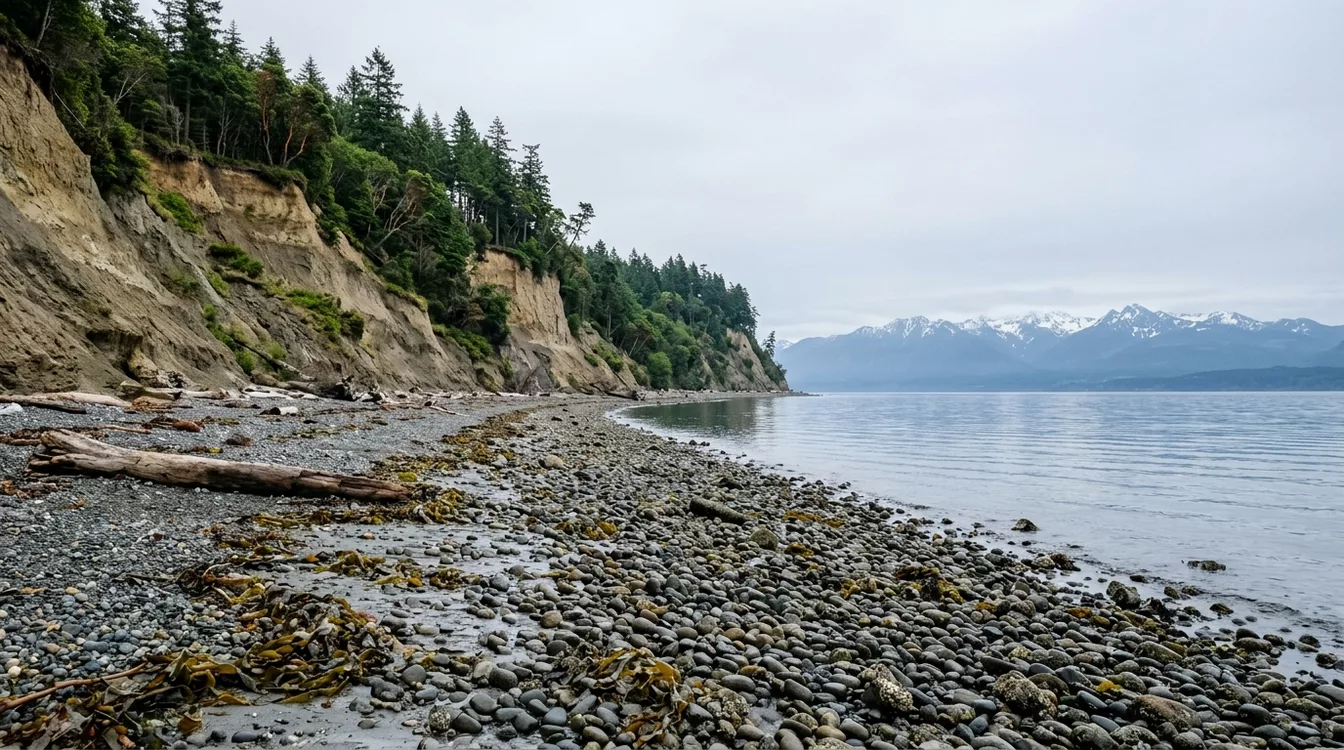
Washington has its own Glass Beach, and it asks more of you than the famous one in California. There's no boardwalk and no parking lot at the edge of the glass. You walk to it, along a strip of cobble below a tall bluff west of Port Townsend, and you can only get there when the tide lets you. That's a big part of why serious collectors still talk about it.
The beach sits at McCurdy Point on the north shore of the Quimper Peninsula, facing the Strait of Juan de Fuca. Like Fort Bragg's Glass Beach, the glass here is the leftover of a town dump. Unlike Fort Bragg, the walk keeps the crowds thin, and most of the glass that's left is small and well worn.
Where the Glass Came From
Port Townsend's waste went to the shoreline for decades, which was normal for coastal towns of the era. According to a 2004 history in the Peninsula Daily News, residents dumped garbage at North Beach in the early 1900s. In June 1938 the City Council decided that stretch of shore was too valuable to keep as a dump, had it dynamited (partly to kill rats) and covered over with dirt.
The dumping moved west along the bluffs. Trucks and residents drove to the edge of a cliff roughly 70 feet high and tipped their loads onto the beach below. That went on until 1962, when the dump moved inland to Mill Road. Some cleanup followed, but the broken bottles and jars stayed in the beach and the bluff toe, and the strait has been tumbling them ever since.
That timeline tells you a lot about what you'll find. This is mostly mid-20th century household glass: beer and soda bottles, food jars, medicine bottles, some auto glass. It's younger than the Victorian material at Seaham, so expect fewer old colors and more of the everyday ones.
The Walk From North Beach
Start at North Beach County Park, at the north end of Kuhn Street (5880 Kuhn St), on the west side of Fort Worden State Park. From the parking area, walk west along the shore toward McCurdy Point. Guides put it at roughly 2.5 to 3 miles each way, about 5.4 miles round trip. Glass shows up along the whole route, but the larger pieces concentrate near the old dump site at the point.
The going changes as you walk. The first stretch is easy sand and gravel. Further on you hit sections of big cobblestones slick with seaweed and crusted with barnacles. They're ankle-turners, and barnacles will cut a dog's paws, so take it slow. On your left the whole way is a steep, eroding bluff. There's no safe way up it.
One visitor's planning advice is worth repeating: allow about 2 hours to walk out, 1 to 3 hours to hunt, and about 2 hours back. That's a long day, which is why you have to plan it around the tide.
Tides: The Part You Can't Skip
The beach below the bluff is only passable at low water. Locals suggest going only on a daylight low tide of about 1 foot or lower, and starting while the tide is still falling so you get the most time on the beach. When the water comes back in it rises right up against the bluff. People have been caught out and had to scramble, and the bluff is not somewhere you want to climb.
Port Townsend has mixed tides, two highs and two lows a day of different heights. In summer the lowest tides fall during the day; in winter they tend to fall at night. That makes late spring through early fall the practical season for this hike. Check a tide table for Port Townsend or McCurdy Point before you go, set a turnaround time, and stick to it even if you're mid-find. Watch the water itself too, not just the printed table: wind and swell can push it higher than predicted.
Access below the high-water mark falls under Washington's public trust doctrine, as a city planner explained back in 2004. An old trail down the bluff that people once used as a shortcut has reportedly been closed for safety and private property reasons, so come in along the beach only.
What You'll Find
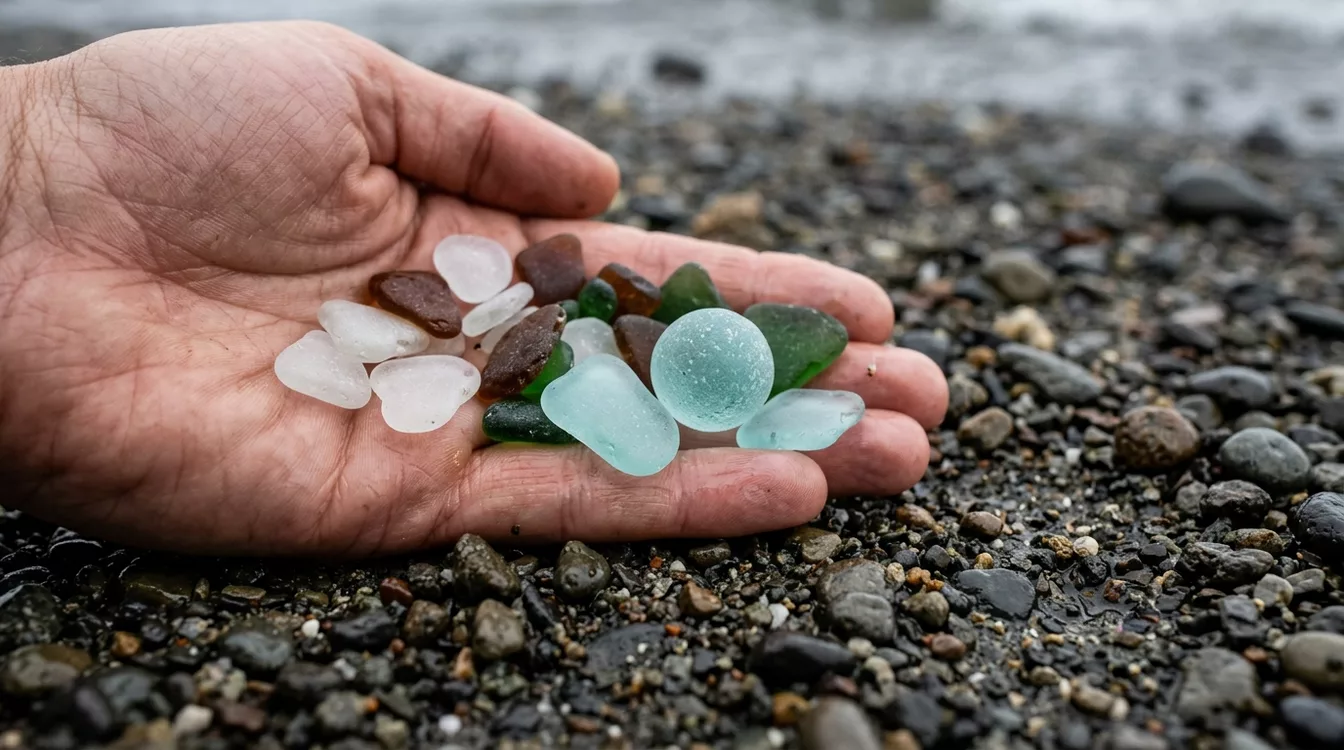
Be honest with yourself about expectations. Decades of collectors have worked this beach, and what's left is mostly small.
Common finds. White (clear), brown and dark green, often dime-sized or smaller. The frosting is usually good, since the pieces have had 60 years or more in the surf. A full bag of small, evenly frosted pieces is a realistic goal, and it suits jewelry makers who want matched sizes.
Worth watching for. Light aqua and soft blue-green from older bottles and jars. Collectors say light blue used to be easier to find here, which tells you it's been picked over, not that it's gone. Look for the odd chunk of thick bottle base or a piece with embossing.
The fun ones. Glass marbles turn up now and then. Nobody seems sure whether they're from a local source or just decades of toys in the dump. Cobalt, red and other rare colors are possible at any dump-site beach, but they're genuinely rare here. Our sea glass color rarity chart shows where these colors rank.
Where to look. The glass collects at the base of larger rocks, where small pebbles pile up behind them. Get low and look at those pockets rather than scanning the open beach from standing height. Some regulars sift with a small hand rake, but leave the bluff face alone: digging into it speeds erosion and it isn't yours to dig.
Best Times to Go
- Season. Late spring to early fall, because that's when the big lows land in daylight. A winter storm can stir up fresh glass, but the low tides that follow are often in the dark.
- Day of week. The North Beach lot holds only about 20 cars and is shared with people heading to the old Fort Worden bunkers. Summer weekends fill up early. Midweek is calmer.
- Timing on the day. Arrive an hour or two before low tide so you reach the point near the bottom of it.
Getting There
Port Townsend is at the northeast tip of the Olympic Peninsula. From Seattle, the quickest route is usually the Seattle to Bainbridge Island ferry, then a drive over the Hood Canal Bridge, around 1.5 to 2 hours in total depending on the ferry. From the Whidbey Island side, the Coupeville to Port Townsend ferry lands right in town. North Beach County Park is a few minutes' drive north of downtown.
The access road runs through a residential neighborhood. If the lot is full and you park on the street, follow the posted signs. Parking rules here can change, so check signs at the lot for any pass requirement before you leave the car.
What to Bring
- A printed or saved tide table and a watch with an alarm for your turnaround time.
- Boots with grip. Wet, weedy cobbles are the main injury risk on this walk.
- Knee pads and a small container. You'll spend a lot of time crouched at the base of rocks.
- Water, food and layers. It's a half-day or longer, and the wind off the strait is cold even in summer.
- A leash. Dogs are welcome on the walk but are required to be leashed, and the barnacles are rough on paws.
Port Townsend vs. Fort Bragg
Both are former dump beaches on the West Coast, and both are past their peak. The difference is effort. Fort Bragg is a short walk from a parking lot, sits inside a state park where taking glass is prohibited, and draws big crowds. Port Townsend takes a long tidal walk, which filters out casual visitors and leaves you with more beach to yourself. If you want to actually hunt rather than just look, Port Townsend is the better day out.
More Sea Glass Locations
Staying on the West Coast? Our Davenport Beach guide covers the Santa Cruz beach known for its rare colors. Further afield, Spectacle Island in Boston Harbor is another former dump that now produces sea glass, or browse the full locations list. If you're new to this, start with our beginner's guide to sea glass collecting and the advice on the best times to find sea glass. And when you get home, add your finds to the free Collection Log.