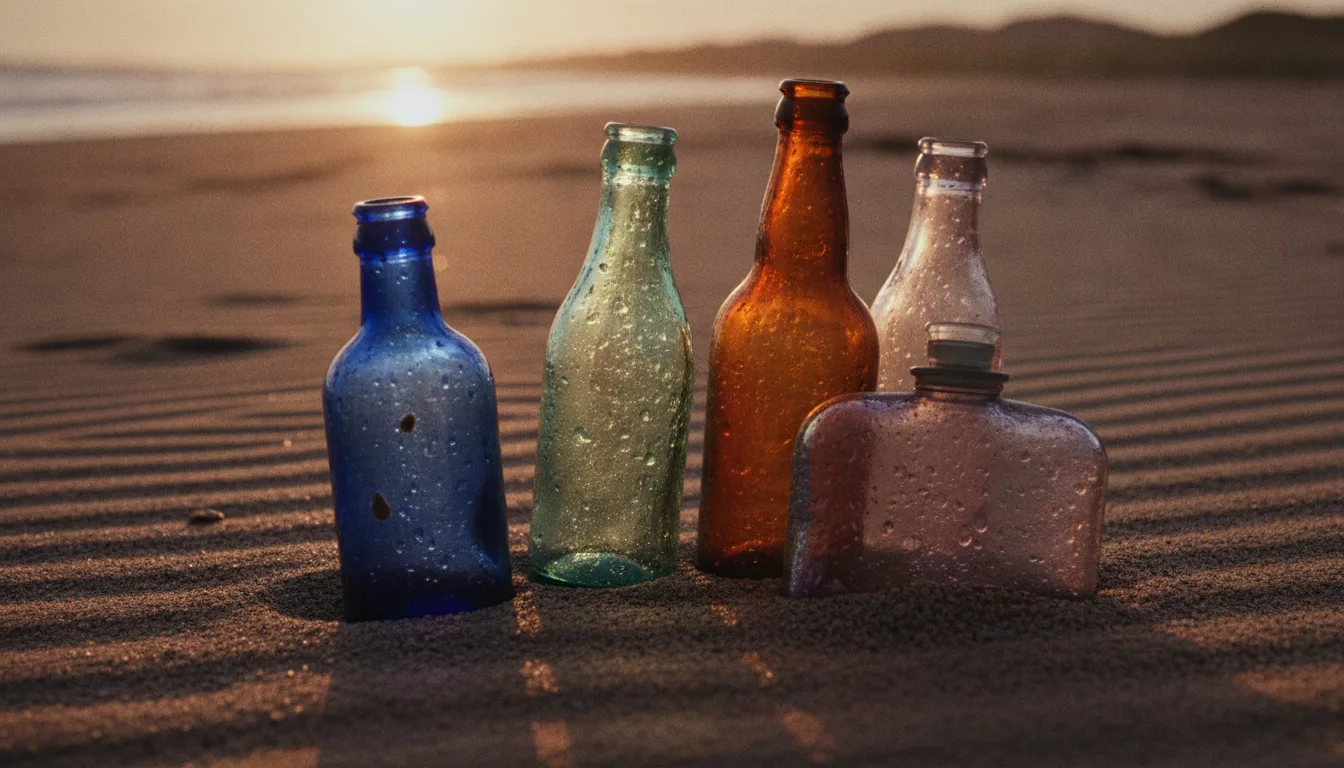
Every piece of sea glass in your collection used to be something else. A medicine bottle. A beer bottle. A window pane, a jar of preserves, a piece of tableware someone dropped off a pier a hundred years ago. Before it was smooth and frosted, it had a maker, a purpose, and a specific year it was manufactured - and that history is written into the glass itself, if you know how to read it.
Most guides to sea glass focus on the ocean's role: the tumbling, the sanding, the decades of wave action that turn a sharp shard into a soft frosted stone. That part is real and important. But the other half of the story happened before the glass ever touched water - in glass factories, on cargo ships, and at the edges of coastal towns that used the sea as their trash can for the better part of a century. Understanding that history explains why certain colors are rare, why some beaches produce glass that others never will, and why the supply is quietly running out.
From Household Object to Ocean Debris
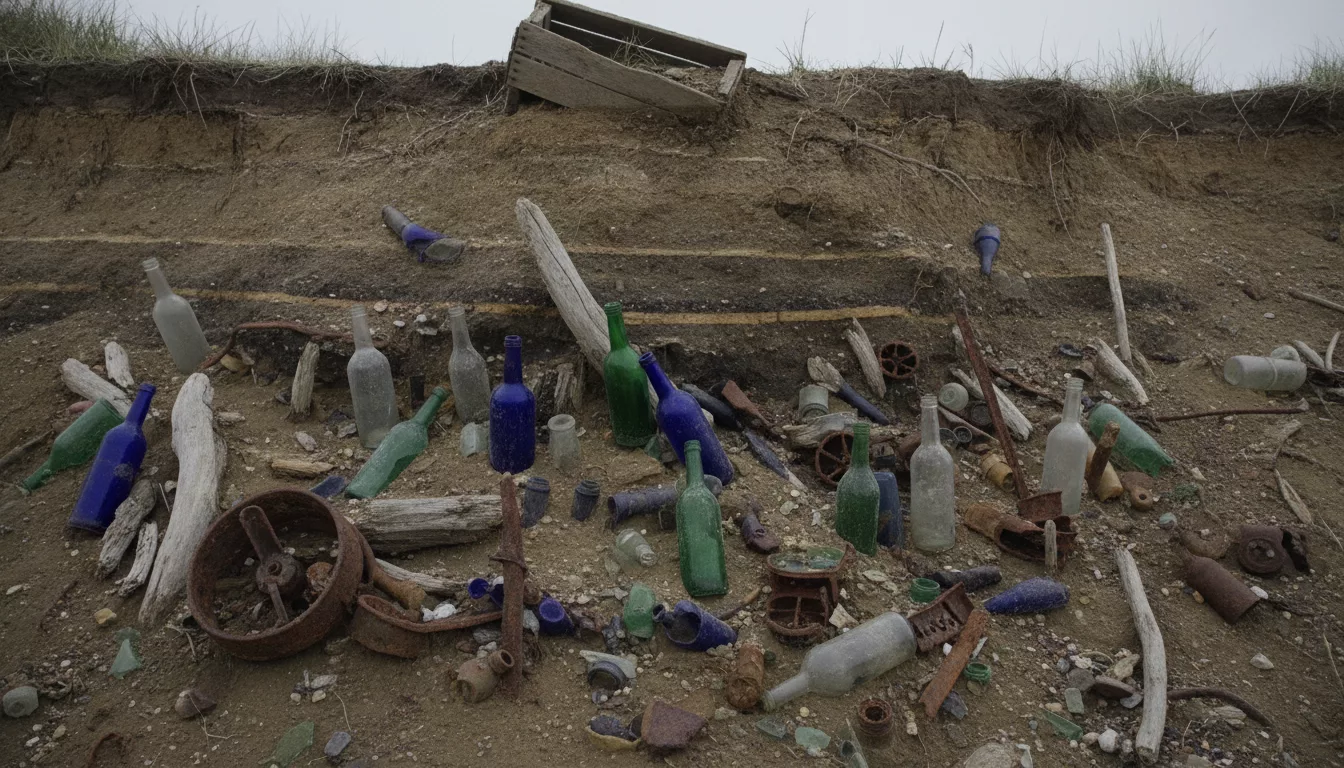
Before modern waste management existed, getting rid of trash near the coast usually meant getting rid of it in the most convenient direction, and for seaside towns that direction was almost always the water. Households threw bottles and broken dishware over seawalls. Fishing communities tossed glass off piers. Entire towns ran open dumps on cliffs and coastal bluffs, letting the tide carry debris away or simply letting the bank erode into the ocean over time.
This wasn't considered reckless at the time - it was just how disposal worked before landfills, recycling, and environmental regulation existed in any organized form. A bottle that missed the trash barrel, or a case of jars that broke during shipping, or a full dump that a town operated for thirty years, all fed the same slow process: glass entering salt water, getting pounded against sand and rock, and eventually washing up unrecognizable as trash.
The Age of Hand-Blown Glass
Glass bottles made before the early 1900s were largely hand-blown, either free-blown or blown into a mold and finished by hand. This process left physical fingerprints that still show up in old sea glass today. A pontil mark - a rough, circular scar on the base where the glassblower's punty rod was snapped off - is one of the clearest signs a piece of glass predates roughly 1860. Hand-finished lips, uneven wall thickness, and small air bubbles trapped in the glass are other telltale signs of this earlier era.
Color during this period was largely accidental. Sand used in glassmaking naturally contains iron oxide, which tints glass a pale green or aqua unless something is added to counteract it. That's why so much surviving 19th-century bottle glass, and so much of the sea glass found today, comes in shades of aqua and pale green - it's not a stylistic choice, it's simply what unrefined sand produces.
The Machine That Changed Everything
In 1903, an American engineer named Michael Owens patented the automatic bottle-making machine, and it transformed glass production within a decade. Bottles that once took a skilled glassblower a minute or more to shape by hand could now be produced by the thousands per hour, with consistent thickness, uniform shape, and a full seam running all the way up through the lip - a detail that hand-finished bottles never have.
Mass production also meant manufacturers could control color more deliberately, adding specific minerals to achieve consistent results across huge batches: cobalt oxide for the deep blue of poison and medicine bottles (blue was often used deliberately so people could identify a dangerous bottle by touch in the dark), chromium for green wine and beer bottles, and carbon or sulfur compounds for the amber "beer bottle brown" that remains one of the most common sea glass colors today. If you want the full breakdown of what mineral produces which color and how rare each one is, our sea glass color rarity guide covers that in depth.
Why Purple Sea Glass Has a 40-Year Expiration Window
This is one of the more interesting facts in sea glass history, and it explains one of the hobby's most prized colors. From roughly 1880 to the early 1920s, American and European glass manufacturers commonly used manganese dioxide as a "decolorizer" - added specifically to cancel out the natural green tint from iron in the sand and produce clear glass.
The catch: manganese is photosensitive. Decades of exposure to ultraviolet light slowly shifts the glass from clear to a soft lavender, and eventually to a deeper amethyst in pieces that got the most sun exposure. Manufacturers switched away from manganese during World War I, when Germany (the primary source) cut off exports, and selenium became the standard decolorizer afterward. Selenium does not sun-color the same way manganese does.
The result is that almost every piece of naturally sun-purpled sea glass you find traces back to a bottle made in that roughly 40-year window before 1920. That's part of why purple is considered a rare, collector-grade find - the raw material stopped being produced a century ago, and no new supply has been added since.
Prohibition, War, and Rationed Glass
Two 20th-century events left their own fingerprints on the sea glass record. During Prohibition (1920-1933), commercial beer and liquor bottles largely disappeared from legal circulation in the United States, replaced by homemade wine jugs, pharmacy "medicinal" whiskey bottles, and improvised containers. Sea glass collectors sometimes find thicker, less refined glass from this period, a byproduct of small-scale and often illegal production rather than standardized factory output.
World War I and World War II caused their own supply disruptions. With manganese imports from Germany cut off during WWI, American manufacturers pivoted to selenium, changing the color chemistry of clear glass permanently, as covered above. During WWII, wartime rationing affected the metals and minerals used in glass coloring, and some manufacturers simplified their color lines to reduce cost and material use - part of why certain rich, saturated colors (deep cobalt, true red, which required gold or selenium-cadmium compounds in careful ratios) became rarer in mid-century production and remain some of the hardest colors to find today.
Historic Dump Sites and Shipwrecks: Where Old Glass Concentrates
Because sea glass depends on old glass entering the water, the richest collecting locations in the world are almost always tied to a specific historical source, not just favorable currents. A few well-documented examples show how directly history and geography connect:
Fort Bragg, California - The beach now famous worldwide as Glass Beach was the site's official town dump from 1906 (after the San Francisco earthquake damaged much of the area, prompting a wave of rebuilding and disposal) until it was closed in 1967. Decades of household glass, and even old cars and appliances, were dumped directly onto the shoreline before cleanup crews removed the large debris and left the glass to keep tumbling.
Seaham, England - This North Sea coastal town produced huge volumes of glass through its Victorian-era bottle works, and the factory reportedly dumped waste glass, including rejected and broken bottles, directly into the sea as part of its normal operations. That single industrial source is why Seaham remains one of the most productive multicolor sea glass beaches in the world, with rare colors like red, yellow, and turquoise showing up more often than almost anywhere else.
Davenport, California - This beach's supply traces to a nearby cement plant and decades of local dumping along the bluffs above the shoreline, which eroded into the surf over time. Our Cardigan Bay, Wales guide covers another location with its own distinct maritime shipping history worth reading if you're planning a collecting trip.
The pattern holds worldwide: find a place with a documented history of coastal glass disposal, industrial glassmaking, or a shipwreck with a cargo of bottled goods, and you've usually found a strong collecting location. It's rarely random.
Why the Supply Is Quietly Running Out
Sea glass is, in a real sense, a finite resource. It depends entirely on glass that was dumped or lost decades ago, and very little new material is being added to that supply today. Several 20th-century changes closed the tap:
Curbside recycling spread through the U.S. and Europe starting in the 1970s, diverting glass bottles away from landfills, dumps, and, by extension, the ocean. Coastal dumping regulations tightened significantly by the mid-20th century, making the kind of direct ocean disposal that created sites like Fort Bragg and Seaham illegal almost everywhere. Plastic packaging also displaced a large share of glass bottle production starting in the 1960s, meaning there's simply less glass in circulation overall to eventually become litter.
None of this means sea glass will disappear soon - there's still a large existing supply working its way through the tumbling process, and it takes anywhere from 20 to 50-plus years for a sharp shard to fully smooth out, so glass discarded in the mid-20th century is still surfacing today. But well-known, heavily collected beaches do measurably slow down over time as their finite local supply gets picked through, which is part of why experienced collectors watch for storms that expose fresh, previously buried material rather than only walking the same stretch of open sand.
Reading Age Clues in Your Own Collection
You don't need to be a glass historian to spot some of these clues in pieces you've already collected. A few quick things to check:
Base marks
A rough, circular pontil scar on the bottom points to hand-finished glass, generally pre-1860s. A smooth, seamless base with a faint circular mold mark is typically later, machine-pressed glass.
Seams
Trace where a seam line runs. If it fades out below the neck, the bottle was likely mold-blown and hand-finished (roughly 1870s-early 1900s). If the seam runs continuously through the lip, it was fully machine-made, meaning 1903 or later.
Thickness and bubbles
Older hand-blown glass tends to have more variation in wall thickness and more visible air bubbles than modern machine-made glass, which is remarkably uniform by comparison.
Embossing
Raised lettering, often a maker's name, city, or "not to be refilled" warnings on medicine bottles, can sometimes be looked up directly, giving you an approximate manufacturing date and even the specific company that made the original bottle.
If you're just starting to build a collection and want the fundamentals on where and when to look, our beginner's guide to sea glass collecting covers the basics that pair well with this historical context. And if you want to know which colors these old bottles typically produced and how rare each one is today, the sea glass color rarity chart is the natural next stop.
Frequently Asked Questions
Why does old sea glass turn purple?
Glass makers between roughly 1880 and the early 1920s used manganese dioxide to keep glass clear, since it canceled out the natural green tint caused by iron impurities in sand. Manganese reacts to ultraviolet light over time and slowly shifts from clear to pale lavender or amethyst. Glass made after that window normally used selenium instead, which does not sun-color the same way. That narrow manufacturing period is the reason purple sea glass almost always traces back to bottles made before 1920.
How can you tell how old a piece of sea glass is?
A few physical clues point to age. A pontil mark, a rough round scar on the base left by the glassblower's punty rod, means the bottle was hand-finished, typically before the 1860s. A visible seam running only partway up the body, stopping below the neck, points to a bottle finished by hand after being blown in a mold, common from the 1870s to early 1900s. A seam that runs all the way through the lip means the bottle was fully machine-made, which became standard after Michael Owens patented the automatic bottle machine in 1903. Thickness and bubble patterns can help too, since older hand-blown glass tends to be less uniform than modern glass.
Why is sea glass becoming harder to find?
The supply of sea glass depends on glass that was dumped or littered decades ago, and that supply is not being replenished the way it once was. Curbside recycling programs that spread through the United States and Europe from the 1970s onward diverted glass away from landfills, beaches, and open dumps. Coastal dumping was also outlawed in most countries by the mid-20th century, and plastic packaging replaced a large share of glass bottles starting in the 1960s and 1970s. Collectors are essentially working through a finite stock of old glass, which is why well-known historic dump sites get picked over and beaches near them slowly produce less over time.
Did people always throw glass into the ocean on purpose?
Yes, for a surprisingly long time this was normal practice rather than an accident. Before organized waste management existed, coastal towns commonly dumped household trash, including glass bottles and jars, directly off cliffs, piers, or seawalls into the ocean, or into open pits that eventually eroded into the water. Some sites, like the dump that became Glass Beach in Fort Bragg, California, were official municipal dumping grounds used for decades. It was only in the mid-1900s, as environmental regulation caught up with population growth, that this kind of ocean dumping was phased out.